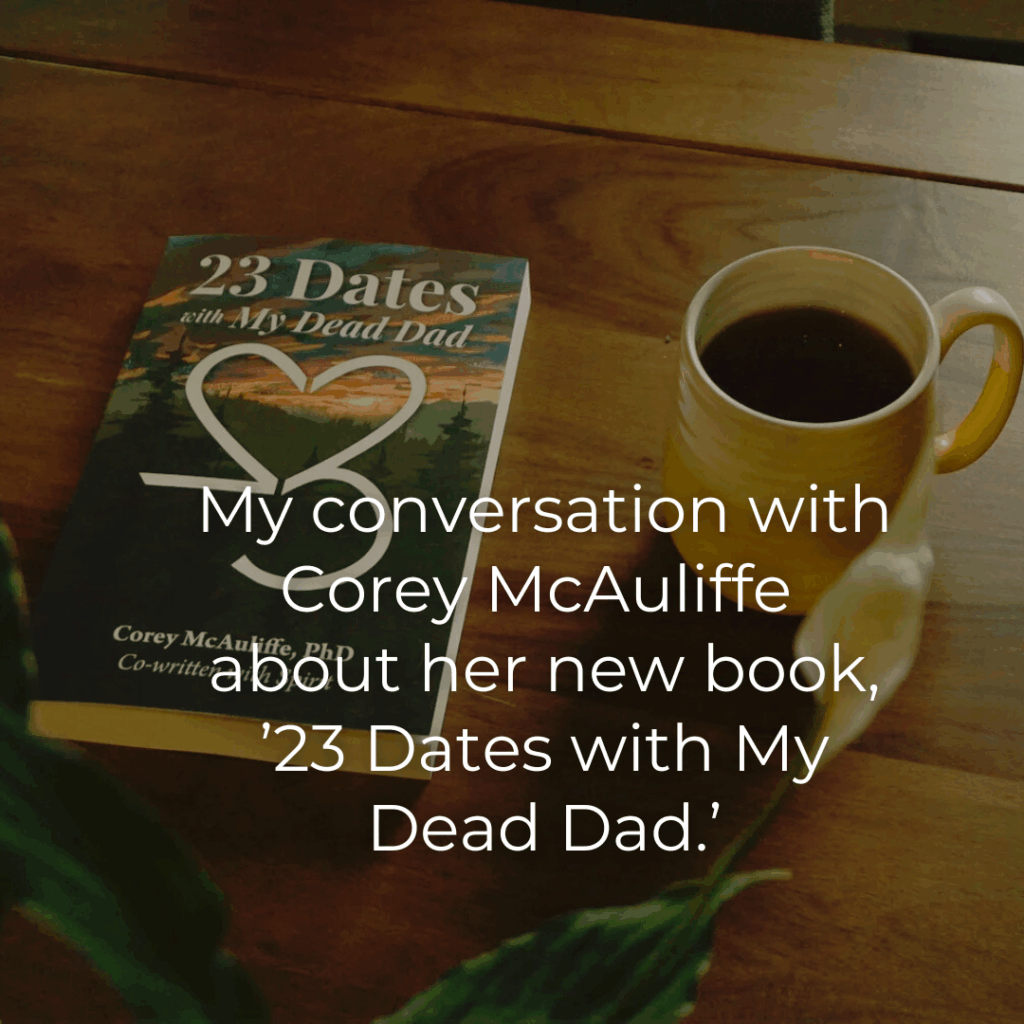





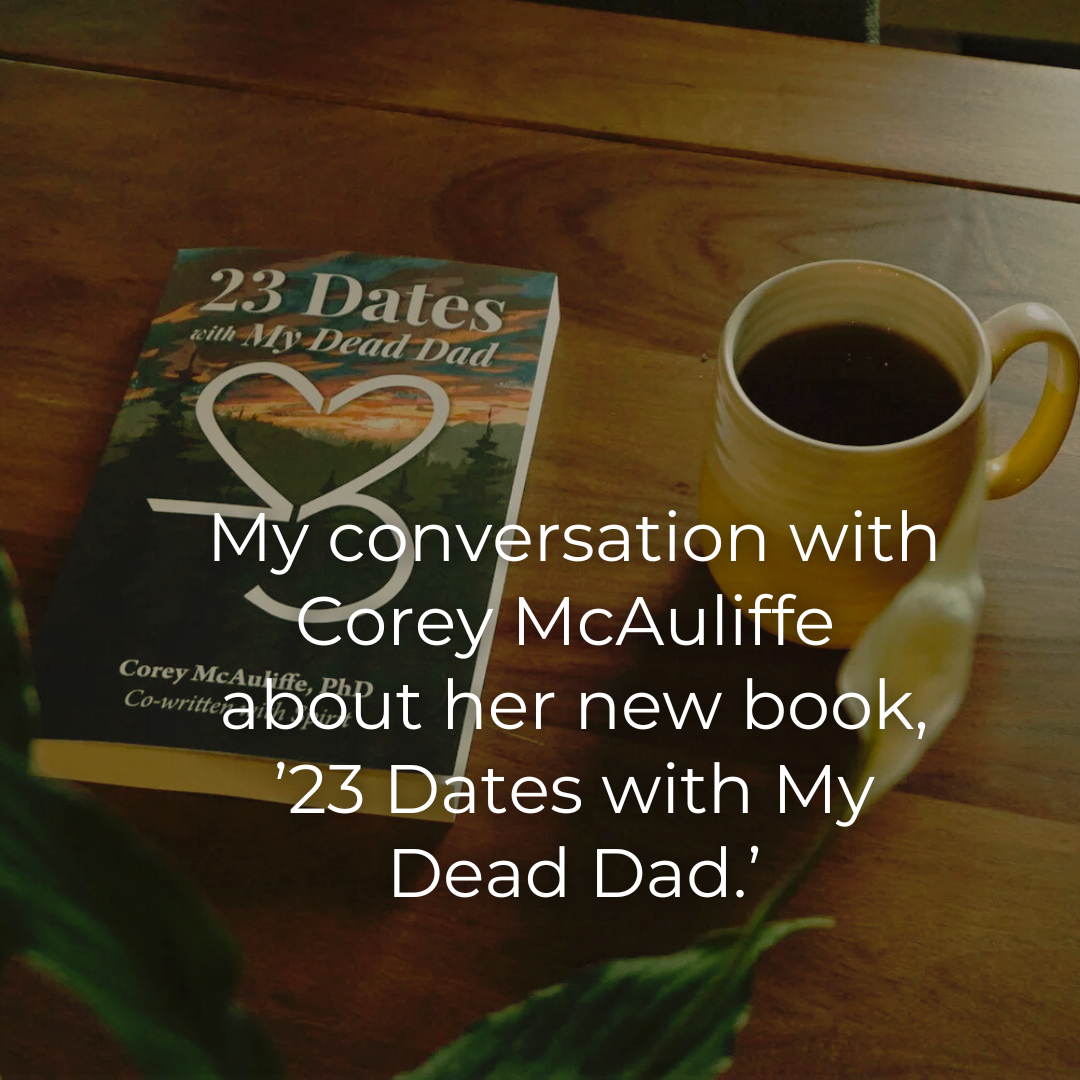

My conversation with Corey McAuliffe about her new book, ’23 Dates with My Dead Dad.’
There’s a moment, early in Corey McAuliffe’s book, when she’s standing in front of rescued horses at a sanctuary outside Toronto. She’s gone there on a date with her dead father. She can feel something, like a flicker or a whisper of him. And then it fades, and she asks the question that every grieving person asks in the privacy of their own mind: Am I completely and totally making this all up?
I love that she leaves that line in. A lesser writer would have edited out the doubt, but Corey lets you sit in it with her. And that’s how you know you’re in good hands.
I first met Corey in the summer of 2022. She called for a consultation, a phone session where someone tells you the surface story first and then, if the trust’s there, the real one starts to come through. A week later, we did a past life regression together, by phone, her in her world and me in mine, both of us following the thread of something older than either of us could put a finger on. That’s how it works sometimes. You meet someone in the present and realize you’ve been circling each other for lifetimes.
She was already writing her book then, though I don’t think she knew yet what it would become. And now, years later, here it is, published, finished, and sitting on my shelf in hardcover with my words on the back.
But I’m getting ahead of myself. Let me tell you about this book. And the love story inside it that I think might be the most honest Valentine I can offer you this year.
The thing about losing someone
Corey’s father, Doug McAuliffe, died on January 19, 2019. He was a man who ironed everything. His clothes, his daughters’ clothes, and probably the air around him if he could have managed it. He wore Eternity by Calvin Klein so faithfully that people smelled him before they saw him. When his daughter got her first pimple, it wasn’t her mother who showed up with the concealer. It was Doug. He had the precision of a man who understood that presentation was a form of care.
He was also an alcoholic. And Corey doesn’t flinch from that.
But before I get to the hard parts, I want to tell you about one of the most quietly revolutionary reframes I’ve encountered in years of grief work. When people offered Corey their condolences and their I’m sorry for your loss comments, she received them graciously. But that’s not how the experience actually lived in her body.
“It felt more like misplacing something than losing it,” she told me. “Like when we say, ‘I lost my keys,’ but what we really mean is, ‘I can’t find them.’ They’re there somewhere; I’m just not sure where.”
Misplaced, not lost. Read that again and let it settle.
That single distinction is the difference between a door that’s been slammed shut and one that’s simply been closed, and might, with enough patience and attention, swing open again.
“That’s what it felt like with my dad,” Corey said. “And while I can’t fully explain why, I knew he wasn’t truly gone, and that knowing lived in my body.”
So she went looking to learn where love goes when the person is no longer here in the way they used to be.
Corey holds the complexity of loving someone who is both your best friend and the person whose illness you can’t fix. She writes about it with the unflinching clarity of a researcher (she has a PhD in Social and Behavioural Health Sciences) and the tenderness of a daughter who still, all these years later, sits inside the question, ‘If he truly loved me, why couldn’t he just stop?’
“Intellectually, I know that’s not how addiction works,” she told me. “Emotionally, it’s still something I’m working to untangle. Loving my dad as an adult meant learning how to live inside that tension without shutting my heart down, and without abandoning myself either.”
If that isn’t the entire curriculum of love in one sentence, I don’t know what is.
A love language no one teaches you
When Doug died, the number 23 started showing up everywhere on clocks, receipts, and in the timestamps of emails that carried life-changing news. It wasn’t a number that had ever meant anything to Corey before. And if you’re already skeptical, she was too. She says so, right there on the page.
But the 23s kept coming. And eventually, they became something she could only describe as a new love language, a way her father was saying, from wherever he was, I’m here. I see you. I’m celebrating with you.
I asked her what it takes to learn a love language with someone after they’ve died. Her answer was disarmingly simple. “It’s not that different from what happens with the living. Love changes as we change. Staying close often means having to adapt how we relate.”
And then she said something that I’ve been carrying around in my body ever since. “Connection asks for curiosity and patience. Some days it feels effortless and clear, and other days it feels like hitting a wall. And even then, it’s still a relationship.”
Still a relationship. Not a memory or a haunting. Not denial. A relationship. One that takes effort and patience and showing up, even when showing up looks nothing like it used to.
The body knows
There’s a scene in the book that I had to read a few times. Corey is in a family constellation therapy session, and she’s asked to face the figure representing her autoimmune condition, the thing that has terrified her and she’s been fighting. And when she finally embraces it, the figure says, “I’m only here because I have to be. I just want to give you a hug and to tell you I love you.”
Here’s what Corey understands, and what I’ve watched unfold in my own practice for decades: the body is not the enemy. Symptoms are communication. The body’s way of saying, Something needs care. Something needs to change. It’s a signal, not a punishment.
“In the long run,” Corey told me, “the autoimmune figure became my teacher, not the villain. It’s not there to punish me, but to offer a different way.”
She also said something that I think every human being in a productivity-obsessed culture needs to hear. “Even on a day when nothing gets done, staying alive is still a win.”
Turning the boat around
There’s a metaphor Corey uses throughout the book. It’s the image of swimming upstream, gripping the oars and fighting the current of your own life, versus the radical act of turning the boat around and letting the water carry you.
“It’s not a one-time decision,” she told me. “It’s a practice. The biggest difference now is awareness. My chest starts to constrict and feel tight. Ah. We’re swimming upstream again. And then comes the real question. What would it feel like to stop fighting the current?”
This is where her father’s presence becomes something more than memory or nostalgia. She describes it as a tap on the shoulder. Not pushy or loud. Just, Slow down. Look around. Come back into your body.
“Ease doesn’t mean doing nothing,” she said. “It means using energy with discernment. Not everything needs to be earned through struggle. Sometimes the wiser move is to save energy for what matters.”
She added this last part quietly, almost as an afterthought, but I caught it — “sometimes it’s not about going upstream at all. Sometimes it’s about staying grounded in the boat while moving through the rapids.”
I think most of us are white-knuckling the oars right now. And this is a book that gives you permission to loosen your grip.
Two books, one conversation
I’ll be transparent with you here, because this is a special Valentine’s newsletter and transparency is its own kind of love offering.
Years ago, I wrote a book called Conduit. It’s the story of my son Connor and our soul-to-soul connection before, during, and after his life. Connor was twenty-two when he was killed by a distracted driver who ran a red light in a crosswalk in Salem, Oregon. He was my only child, my spiritual guide in human form, and the relationship that taught me everything I know about the thin veil between this world and the next.
After Connor transitioned, I didn’t “move on.” (I dislike that phrase almost as much as I dislike “lost the battle.”) I moved deeper into the connection and the understanding that he hadn’t left, but expanded. Connor 2.0, I called him. Millions of times more powerful and joyful in his non-physical form than the constraints of a body ever allowed.
So when I read Corey’s book, I wasn’t reading as a casual observer. I was reading as someone who has lived this and knows what it’s like to stand in the canyon between the living and the dead and discover it’s not a canyon at all but a doorway you can keep walking through.
Corey opens her book with the line, “One may imagine a canyon-size pit of distance between the living and the dead. Yet when my dad died in 2019, that wasn’t my experience.”
And I thought, no, it wasn’t mine either.
What Corey does brilliantly and what made me want to put her book in your hands this Valentine’s week is that she gives you the most honest, vulnerable, unexpectedly funny map for what it looks like to keep a relationship going after someone dies, not in theory, but in practice. In car rides to dog rescues and walks through Japanese gardens and quiet moments where she says to her dead father, Come with me, and means it.
The love we’re actually talking about
I asked Corey, What does ongoing love with the dead actually look like in practice? What does it ask of you? What does it give?
Her answer: “It looks a lot like loving the living. It takes effort, patience, and showing up, even when showing up looks different than it did at the beginning.”
And then, “This relationship is much more for the living than those who have passed. In my experience, spirit always shows up as their whole self, no longer carrying the same challenges from their life on earth. Instead, their love comes through as full and complete. On this side, we judge. We misunderstand. We criticize. But from his side, what comes through is peace. Love. A steadiness.”
Steadiness is a word that lands in my chest and stays there, because isn’t that what we’re really looking for on Valentine’s Day and every other day? Not a grand gesture or a romantic comedy climax. But someone — in a body or out of one — who shows up steady. Who says, through a number on a clock or a wave of warmth in the chest or a feeling you can’t explain to anyone who hasn’t felt it, I’m still here. I still love you. I’m not going anywhere.
My Valentine to you
So here’s what I want to offer you.
If you’ve lost someone and you’re still in conversation with them through signs, dreams, or a feeling in your body that defies every rational explanation, you’re not making it up or in denial. You’re in relationship. And that relationship is as real and as sacred as any love story that gets a Valentine’s card.
Corey’s book didn’t just confirm what I already knew. It reminded me that love is not a fixed thing. It changes shape and follows you across thresholds. It shows up as the number 23 on a clock, or a sudden smell of cologne that no one in the room is wearing, or the voice of your son in a meditation that feels more real than anything in the three-dimensional world.
And if you haven’t lost someone yet, if all your people are still here in their bodies, still answering the phone, still leaving you texts that start with “Hi, it’s me…” — love them now. Love them in the tension and the imperfection and the places where you can’t fix them, and they can’t fix you. Love them in all the shapes love has to take.
That’s the Valentine. That’s the whole thing.
***
Corey McAuliffe’s 23 Dates with My Dead Dad is available now. You can learn more about her work and order the book at www.coreymcauliffe.com
My endorsement for the back cover: “This book doesn’t just talk about grief. It invites it to dinner, laughs with it, argues with it, and loves it anyway. Corey McAuliffe makes the invisible relationship after death feel real, vivid, and alive.”
Happy Valentine’s Day. Go be in relationship with all of it.
Jonni